As an Amazon Associate, we earn from qualifying purchases. Some links on this site are affiliate links at no extra cost to you. Our recommendations are based on thorough research and editorial judgment.

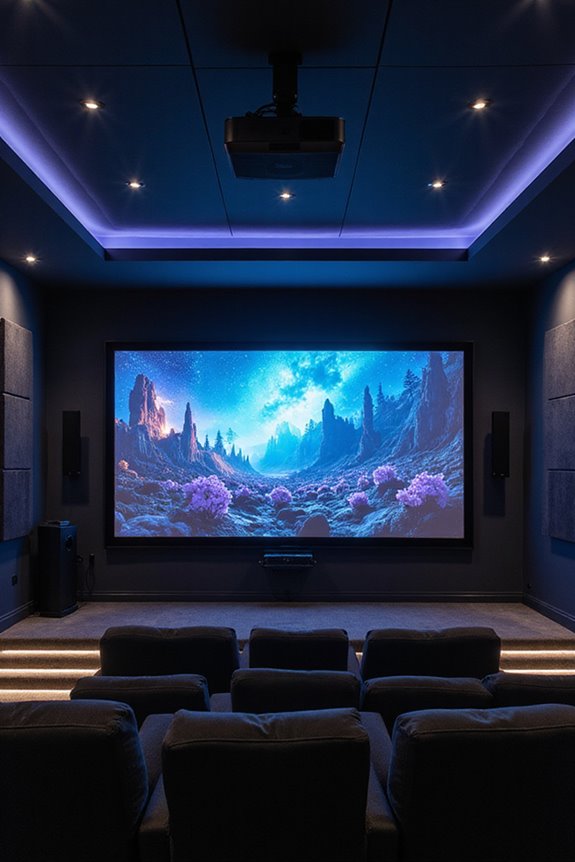
How Many Lumens For Home Theater?

When setting up your home theater, lumens play a key role in image quality. For pitch-dark rooms, aim for 1,000 to 2,500 lumens. If there’s moderate ambient light, you’ll need at least 2,500 to 3,500 lumens, while bright rooms require 4,000 lumens minimum. For screen sizes, use 2,500 to 3,000 lumens for 80”-100”, and 3,500 to 5,000 lumens for larger screens. Understanding these specifications will help you choose the best projector for your space, so let’s explore this further.
Key Takeaways
- For pitch-dark rooms, aim for 1,000 to 2,500 lumens to achieve good image quality.
- In moderate ambient light, choose projectors with 2,500 to 3,500 lumens for adequate brightness.
- Bright rooms require a minimum of 4,000 lumens to prevent washed-out images.
- For 80″ to 100″ screens, 2,500 to 3,000 ANSI lumens are recommended for clarity.
- Always balance brightness with color accuracy to enhance overall viewing experience.
Understanding Lumens and Their Importance in Home Theater
When setting up a home theater, understanding lumens is essential for achieving the best viewing experience. Lumens measure the total amount of visible light emitted by a source, quantifying brightness perception as seen by the human eye. Higher lumen measurements mean better image clarity and detail, especially in bright environments.
Here’s why lumens matter:
- Brightness: They influence how vivid colors look on screen.
- Screen Types: Different screens can reflect light differently, affecting visual quality.
- Projector Type: Various technologies, like LED or laser, have different lumen outputs. Additionally, the ideal brightness rating, typically around 700 ANSI lumens, is important for outdoor projectors to ensure clarity in well-lit environments.
Recommended Lumens Based on Room Conditions
Choosing the right number of lumens is vital for your home theater, and it largely depends on the room conditions. Here’s a quick breakdown of what you need based on your specific environment:
- Pitch-Dark Rooms: Aim for 1,000 to 2,500 lumens. This guarantees good image quality, especially with smaller screens around 1,300 lumens.
- Moderate Ambient Light: You’ll want at least 2,500 to 3,500 lumens. This assists in maintaining brightness when lights are present.
- Bright Rooms: A minimum of 4,000 lumens is essential here. If you’ve got lots of natural light or lighting sources, this helps avoid washed-out images. Additionally, consider the use of HDMI matrix switches for enhanced connectivity and flexibility in managing multiple devices during viewing.
Consider your room design and the types of lighting sources; these factors directly impact your ideal lumen choice for the best viewing experience.
Lumens Required for Different Screen Sizes
Finding the right number of lumens doesn’t just depend on room conditions; it also varies with the size of your screen. For 80” to 100” screens, 2,500 to 3,000 ANSI lumens generally deliver clear, vibrant images. Increasing to 3,000 to 3,500 lumens suits 100” to 120” screens, maximizing lumen efficiency.
- For large screens (130” to 150”), aim for 3,500 to 5,000 lumens.
- If you’re going above 150”, you’ll need 5,000 to 11,000 lumens. Additionally, consider the brightness levels of different projector models to ensure optimal viewing in various lighting conditions.
Balancing Brightness and Color Accuracy

Achieving the right balance between brightness and color accuracy is essential for ideal home theater experiences. When we focus too much on brightness saturation, we might end up with washed-out colors that detract from the visual enjoyment. It’s vital to maintain brightness within recommended ranges to preserve color fidelity, especially in darker scenes.
To optimize your setup, consider the following:
- Controlled Lighting: Dark rooms allow for lower brightness projectors while enhancing color accuracy.
- Brightness Metrics: Check both color brightness and white brightness; the former is often much lower.
- Calibration: Use tools to adjust brightness to maintain rich colors and vivid contrasts. Additionally, understanding the recommended brightness levels, such as 2,500 lumens for outdoor use, can help you choose the right projector for your home theater.
Selecting the Right Projector for Your Setup
When selecting the right projector for your home theater setup, it’s essential to contemplate several key factors. Understanding your room’s ambient light is vital. Here’s a quick guide:
- Brightness Levels:
- 1,000-1,200 lumens for a completely dark room.
- 1,500-2,000 lumens for minimized light conditions.
- 2,500-3,000 lumens for moderate ambient lighting or larger screens.
- Projector Features:
- Choose a projector with at least 2,000 lumens for versatile use.
- Guarantee it balances brightness and color accuracy. Optimal setup considerations like distance from the screen can significantly impact image quality.
Pay attention to screen size and viewing distance too. A projector that fits your space will enhance your viewing experience and make movie nights truly enjoyable!
Frequently Asked Questions
What Are ANSI Lumens and How Do They Differ From Regular Lumens?
ANSI lumens are a standardized brightness measurement, making them reliable for comparison. Unlike regular lumens, ANSI lumens guarantee consistent brightness across projectors, enhancing our shared viewing experience. They help us choose the right projector for our needs.
Can Lumens Affect the Lifespan of the Projector?
Yes, lumens can definitely affect our projector lifespan. Higher lumen capacities can increase heat, shortening lamp life. To enjoy our projector for years, we should manage brightness levels wisely and pay attention to cooling mechanisms.
How Do I Measure Ambient Light in My Home Theater?
To measure ambient light in our home theater setup, we should use a lux meter at the screen position. Taking multiple readings helps us guarantee ideal lighting conditions for our movie experience together.
Is Higher Lumen Always Better for Picture Quality?
Higher lumens aren’t always better for picture quality. While increased brightness perception can enhance clarity, excessive brightness may wash out colors. We should find a balance for the best viewing experience tailored to our space and preferences.
What Are the Best Projector Brands for High Lumen Output?
For high lumen output, we love Epson, JVC, Sony, and Optoma. By comparing brands, we see that projector brightness truly enhances our viewing experiences, making it easier to find the perfect model for our needs.