As an Amazon Associate, we earn from qualifying purchases. Some links on this site are affiliate links at no extra cost to you. Our recommendations are based on thorough research and editorial judgment.

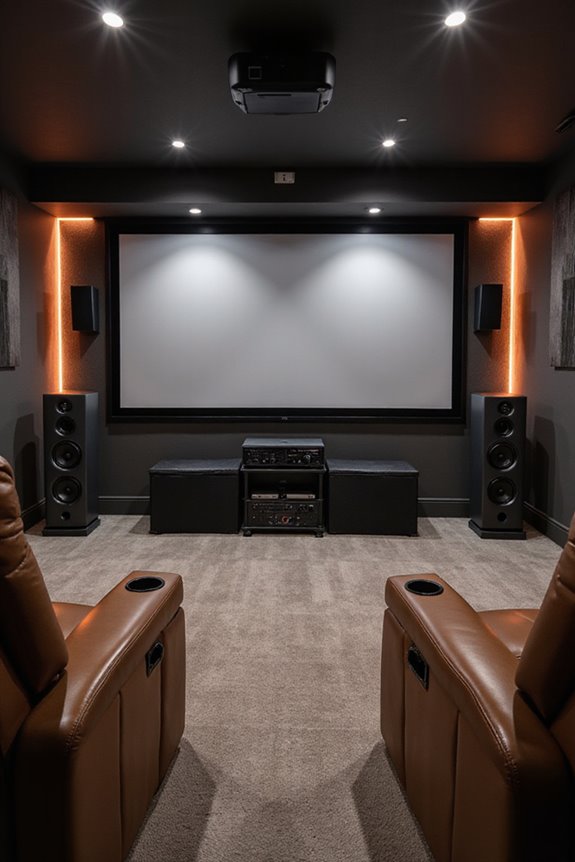
Where To Place Subwoofer?

For ideal subwoofer placement, we should aim for a few key strategies. First, let’s position it near the main speakers to enhance bass imaging. Avoid corners to reduce boomy bass, and consider using the “subwoofer crawl” method to find smooth bass response. If possible, we can utilize multiple subwoofers for even coverage. Finally, remember that furniture can affect sound clarity, so location matters. There’s more to explore about enhancing your sound experience.
Key Takeaways
- Position the subwoofer near the main speakers to improve bass imaging and overall sound integration.
- Avoid corners to prevent boomy bass; instead, find a smooth bass response using the “subwoofer crawl” technique.
- Consider using multiple subwoofers for even bass distribution and to reduce standing waves in the room.
- Make small adjustments to placement, as even minor changes can significantly alter bass clarity and sound quality.
- Ensure the subwoofer is 1-3 feet from walls and away from high-traffic areas for safety and optimal performance.
Importance of Subwoofer Placement
When it comes to audio systems, the placement of your subwoofer is crucial to achieving the best sound quality. It directly influences subwoofer performance and audio coherence. Here are key points to take into account:
- Position your subwoofer near the main speakers for improved bass imaging and a more integrated sound.
- Avoid corners unless you’re prepared for potentially boomy bass; measure and test to find the ideal spot.
- Think about using multiple subwoofers; this can create even bass distribution, enhancing your listening experience.
- Implement the “subwoofer crawl” technique: move around the room to find the smoothest bass response.
- Proper subwoofer placement is particularly important for 5.1 surround sound systems, as it significantly enhances the immersive audio experience.
Making these adjustments can greatly enhance your audio experience, allowing you to feel every note while maintaining balance and clarity.
Understanding Room Acoustics

Understanding room acoustics is essential for ideal subwoofer placement. Room modes, created by our room’s dimensions, cause both peaks and nulls in bass frequencies. This can lead to uneven bass response. Here’s what we need to know:
- Sound Reflection: Hard surfaces reflect bass, creating constructive and destructive interference.
- Subwoofer Placement: Corners excite multiple modes, adding bass but often muddiness. A foot of space reduces excessive bass.
- Room Setup: Furniture affects bass distribution, introducing potential dead spots.
Recognizing these factors helps improve bass clarity and performance. Remember, even moving the subwoofer a small distance can drastically change how bass sounds, so experimenting with placement is key. Additionally, utilizing multi-channel systems can enhance the overall audio experience by creating a richer sound environment. Together, we can find that perfect location for a satisfying listening experience.
The Subwoofer Crawl Method
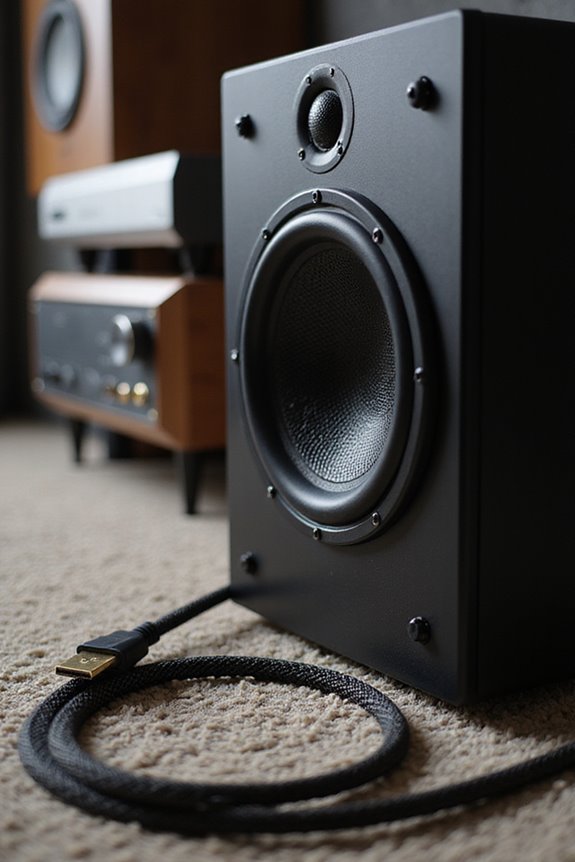
Having a solid grasp of room acoustics prepares us for optimizing subwoofer placement. The Subwoofer Crawl Method is an effective way to find the best spot for our subwoofer. Start by placing the subwoofer at your main listening position and use a long cable for easy movement.
- Play a bass-heavy track on loop.
- Crawl around the room at ear or knee level, focusing on volume and bass characteristics.
- Mark locations with smooth and deep bass. This method can enhance the effectiveness of your surround sound speakers, ensuring a more immersive audio experience.
Ideal Front Wall Placement
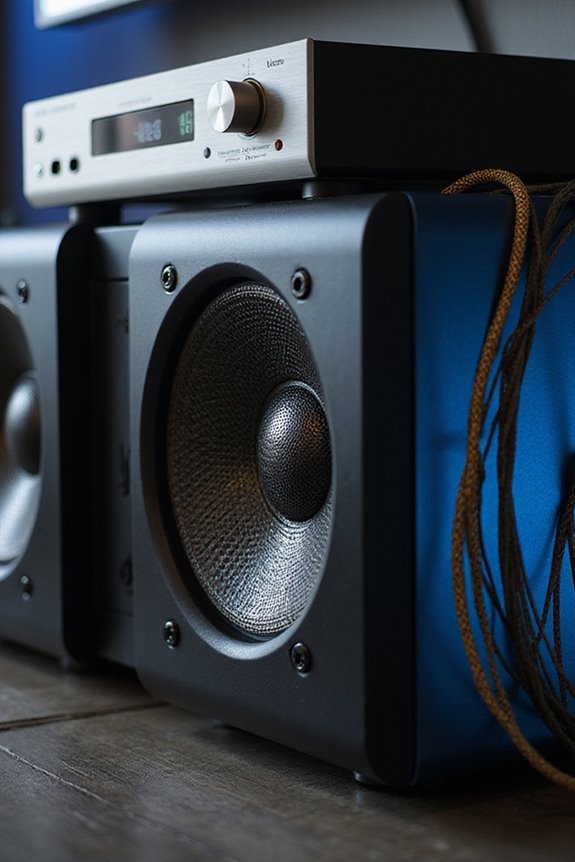
Placing your subwoofer on the front wall can dramatically enhance your audio experience, as it maximizes bass energy coupling and improves overall impact. This positioning offers several benefits, including:
- Boundary Reinforcement: Placing the sub near the front wall excites room modes, creating a punchy bass response.
- Front Wall Integration: Aligning the sub with your front speakers enhances sound staging and imaging, making your listening experience cohesive.
- Calibration Ease: For single sub setups, this placement simplifies using room correction software to smooth out bass peaks.
To maximize performance, offset the sub slightly from the corner, which can minimize extreme peaks while still enjoying optimal coupling. Ultimately, the front wall placement is perfect for smaller home theaters looking for incredible low-frequency output without extensive acoustic treatments. Additionally, this setup can improve sound distribution throughout your space, leading to a more immersive experience.
Avoiding Corner Placement

While the front wall placement of a subwoofer can enhance your audio experience, avoiding corner placement is equally important for achieving balanced bass response. Placing a sub in corners introduces corner acoustics that can exaggerate bass frequencies, leading to muddy sound.
Here are some key considerations:
- Uneven Bass Response: Corners can create peaks and dips in bass, resulting in an unbalanced sound across your room.
- Bass Clarity Degradation: Dense wave interactions in corners complicate clarity, making your music or movies less enjoyable.
- Reflection Issues: Nearby reflective surfaces may further impact sound quality, often leading to distortion. Additionally, advanced calibration technology can help optimize the sound performance of your system, ensuring better bass management.
Distance From Walls and Boundaries
When you’re considering subwoofer placement, the distance from walls and boundaries plays an essential role in achieving ideal sound quality. To maintain powerful bass response, keep your subwoofer close to the back wall, ideally between 0 and 0.78 meters (0 to 2.56 ft). Avoid placing it more than 2.15 meters (7 ft) back to prevent bass loss.
For side walls, pull the subwoofer at least 12 to 18 inches away to reduce boundary reflections that can muddy the sound. If you can, use the “rule of thirds” for even bass, positioning it about one-third of the room length from the wall. These adjustments help balance sound, ensuring you experience the fullness of your audio equipment.
Acoustic Considerations
Acoustic considerations are essential in enhancing subwoofer performance in your space. Understanding the types of subwoofers and their frequency response helps us make informed placement choices.
- Ground Coupling: Placing the subwoofer on the floor enhances low frequencies by +3dB to +6dB, but it may create uneven bass distribution.
- Pressure Management: Use measurement tools to visualize pressure uniformity, ensuring a balanced bass experience across key frequency bands.
- Vertical Positioning: While floor placement provides benefits, experimenting with height can help mitigate standing wave issues.
Multiple subwoofers can improve overall sound quality by averaging room modes, reducing peaks and nulls. Remember, each room is unique, so don’t hesitate to test different placements for best results.
Testing for Optimal Position
Finding the ideal position for your subwoofer can greatly enhance your audio experience. Let’s explore how to test for the most effective placement together.
- The Subwoofer Crawl Method:
- Start at your main listening position, placing the subwoofer near ear height.
- Play bass-heavy music, crawling around the room at subwoofer height to find the best frequency response.
- Move the subwoofer in small increments along the walls.
- Listen for bass fullness and blending at your seating position.
- Utilize measurement software to analyze frequency response, looking for peaks and dips.
- Rectangular rooms are preferred for predictable sound behavior.
- Square rooms may create uneven bass due to standing waves; consider asymmetrical placement to mitigate this.
- Irregular rooms require flexible positioning and sound diffusion techniques.
- Two subwoofers: Position midway along opposing sidewalls for balanced bass.
- Four subwoofers: Place in each corner for maximum output and to reduce standing waves.
- Use identical or closely matched subs for smoother calibration.
- Employ tools like Room EQ Wizard (REW) to analyze frequency responses.
- Adjust phase and delay settings via your audio receiver for ideal integration.
- Furniture Materials: Soft upholstered couches absorb excess bass, reducing muddiness, while large, hard furniture can block bass waves, limiting clarity.
- Furniture Shapes: Arranging furniture to avoid enclosed spaces helps prevent “boomy” bass.
- Spatial Arrangement: Aim for open lines between the subwoofer and seating.
- Use of Diffusers: Bookcases can diffuse sound and minimize standing waves, enhancing bass clarity.
- Cable Management: Secure and hide cables to prevent tripping hazards. Use cable raceways or clips for a clean look. If possible, think about a wireless subwoofer to eliminate cable risks entirely.
- Safe Handling: Position your subwoofer away from high-traffic areas to avoid accidental knocks. Elevating it slightly improves access to controls.
- Distance from Walls: Keep 1-3 feet away from walls to avoid imbalanced bass. Testing different spots can help you find the best sound and safe placement.
- Regular Maintenance: Check cables regularly for wear, and always turn off equipment before adjustments. This guarantees safety during operation.
These steps will help us achieve subwoofer isolation and a balanced sound profile. Happy experimenting!
Adjusting for Room Shape and Size
Adjusting for the shape and size of your room can substantially impact how well your subwoofer performs. We must consider room dimensions to avoid overpowering bass or weak lows. In smaller spaces, bass can become boomy, overpowering other frequencies, while larger rooms might dilute bass energy.
Here are key points to help you:
Don’t forget the importance of acoustic treatments, like bass traps, to improve bass clarity. With careful adjustment, we can enjoy well-balanced sound no matter our unique space!
Utilizing Multiple Subwoofers
When it comes to enhancing our audio experience, how do we effectively utilize multiple subwoofers? By strategically configuring our subs, we can achieve improved bass coverage and consistency.
Placement Strategies:
Calibration Techniques:
Furniture Placement and Its Effects
The placement of furniture can greatly influence our subwoofer’s performance, so it’s essential to reflect on how every piece interacts with sound waves.
Practical Safety and Accessibility Tips
Guaranteeing your subwoofer is safely and conveniently placed is crucial for both sound quality and accessibility. Here are some practical tips to take into account:
Frequently Asked Questions
Can I Place My Subwoofer Horizontally Instead of Vertically?
Absolutely, we can place our subwoofer horizontally instead of vertically! While sound quality might vary slightly, experimenting with subwoofer orientation helps us find the perfect spot that suits our listening experience and room layout.
Does Subwoofer Placement Affect Audio for Movies Versus Music?
Absolutely, subwoofer placement dances between movie soundtracks and music genres. Each location transforms our experience, weaving depth and richness into every bass note, inviting us to feel immersed in rhythm and cinematic adventure together.
Will a Subwoofer Work Well in a Small Room?
Absolutely, a subwoofer can work well in a small room! By considering bass performance and placement, we can enjoy the benefits of deep, rich sound without overwhelming the space. Let’s maximize that audio experience together!
How Do I Know if My Subwoofer Is Too Powerful?
We can tell our subwoofer’s too powerful if we notice distortion or have to adjust the power settings frequently. If our bass overwhelms the music, it’s time to reconsider the balance for a better experience.
Can Furniture Weight Impact Subwoofer Performance?
Absolutely, furniture weight can impact subwoofer performance. It influences subwoofer vibration and alters furniture acoustics, potentially diminishing sound clarity. We should be mindful of placement and isolation to enhance our listening experience together.