As an Amazon Associate, we earn from qualifying purchases. Some links on this site are affiliate links at no extra cost to you. Our recommendations are based on thorough research and editorial judgment.


In Wall Speakers Vs On Wall Speakers

When deciding between in-wall and on-wall speakers, consider their key differences. In-wall speakers blend into your walls for a sleek look but may require professional installation, and can cost up to $3,000. On-wall speakers are more visible and generally easier to install, with prices ranging from $150 to $800. Regarding sound, in-wall options minimize reflections and enhance bass, while on-wall types deliver clearer midrange and highs. There’s more to explore about each choice’s features and benefits.
Key Takeaways
- In-wall speakers provide a seamless design and minimal visibility, enhancing aesthetics, while on-wall speakers offer better sound quality due to their exposed positioning.
- In-wall installation typically requires professional help, leading to higher overall costs compared to DIY-friendly on-wall speakers.
- Sound quality differs: in-wall speakers excel in bass response, while on-wall speakers provide clearer midrange and high frequencies.
- Placement flexibility is greater with on-wall speakers, allowing adjustment to avoid sound reflections, while in-wall speakers are constrained by wall construction.
- Both types have unique advantages and should be chosen based on personal preferences, installation considerations, and room acoustics.
Definition of In-Wall and On-Wall Speakers
Choosing between these options depends on your needs. In-wall design offers minimal visibility, while on-wall performance delivers richer sound quality. Ultimately, your decision can greatly enhance your audio experience in any setting. Additionally, it is essential to consider frequency response when selecting the right speakers, as it impacts the overall sound quality.
Installation Process for In-Wall Speakers

Installing in-wall speakers can transform your audio setup and enhance your listening experience. Before diving in, let’s prepare for potential installation challenges. First, we’ll use a stud finder to locate wall studs and mark speaker positioning symmetrically. We recommend keeping the tweeter height around 42 inches for maximum sound.
Here’s what you’ll need:
- Essential tools: stud finder, drywall saw, drill, level, and wire strippers.
- UL-rated in-wall speaker wire for compliance and quality.
Carefully cut the drywall and route speaker wires through the cavities. Once everything’s in, dry-fit the speakers for adjustments. Secure them with mounting clamps, ensuring a flush fit. Finally, test your setup, confirm sound quality, and tidy up any disturbance to your walls. Additionally, selecting speakers with high signal-to-noise ratios can significantly enhance your audio clarity and overall listening experience.
Installation Process for On-Wall Speakers

When setting up on-wall speakers, taking a measured approach can make all the difference. First, we need to identify ideal speaker placement, keeping room acoustics and listener position in mind. Using a stud finder helps us avoid wall studs and wires. We’ll mark locations with the provided template and drill pilot holes to check for obstructions.
Next, we run the speaker wire from the amplifier to the speaker locations. We’ll secure it along the wall with cable clips or raceways. When mounting our speakers, it’s essential to use the specified mounting brackets, securing them carefully to prevent damage. Finally, let’s tidy up any visible wires and test the audio system to confirm everything’s functioning perfectly. Additionally, considering room size compatibility can significantly enhance the overall audio experience.
Sound Quality of In-Wall Speakers

In-wall speakers offer several advantages when it comes to sound quality, making them a popular choice for home audio setups. Their acoustic design minimizes sound reflections, leading to improved sound performance by reducing unwanted peaks and dips. The wall serves as a baffle, boosting bass response by around 6 dB, enhancing those lower frequencies you’ll notice in music and movies.
Key features include:
- Larger driver sizes for a wider soundstage
- Controlled directivity, improving imaging and phase coherence
- Strategic placement reduces distortions and enhances spatial accuracy
While some budget in-wall models may compromise on bass and loudness, well-engineered options provide an immersive listening experience, offering clear instrument separation. Proper calibration can guarantee a balanced sound profile tailored to your space. Additionally, in-wall speakers can support advanced sound technologies like Dolby Atmos, which provides a three-dimensional audio experience.
Sound Quality of On-Wall Speakers
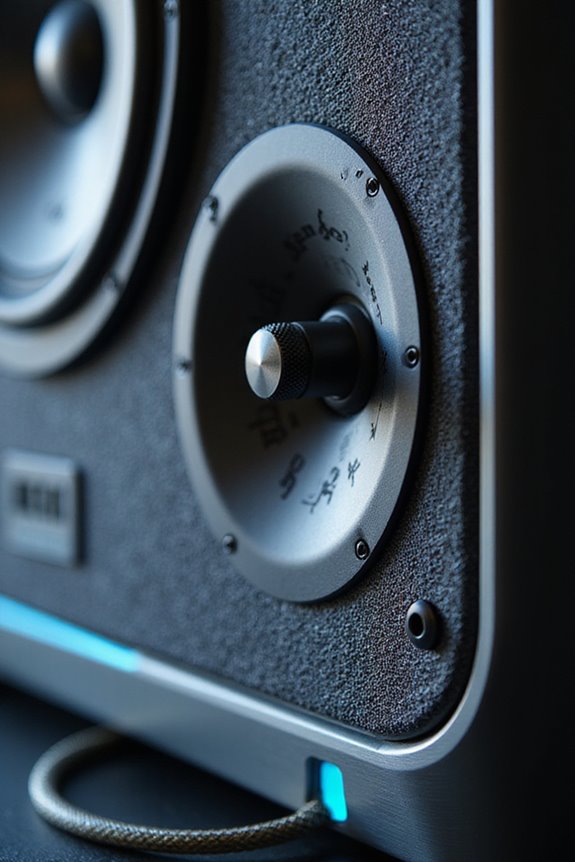
On-wall speakers offer a distinct listening experience compared to in-wall models, primarily due to their mounting position and design. Their proximity to walls can impact sound dynamics, leading to reflections that might reduce bass response.
To get the best out of them, placement matters—avoid corners and guarantee proper angling. Modern designs, however, cleverly integrate advanced driver arrangements and built-in amplifiers, providing clearer midrange and high frequencies. Additionally, systems with dedicated subwoofers can significantly enhance bass performance in on-wall setups.
Here are key points about on-wall speakers:
- Work well in smaller living spaces.
- Can deliver immersive surround sound experiences.
- Require thoughtful acoustic treatments for ideal sound clarity.
Cost Comparison: In-Wall vs. On-Wall
While weighing the cost differences between in-wall and on-wall speakers, it’s essential to assess not just their purchase prices but also installation and additional equipment expenses.
- Purchase Prices: On-wall speakers typically range from $150 to $800, whereas basic in-wall speakers start lower but can match those prices with high-end options costing up to $3,000.
- Installation Costs: In-wall speakers require professional installation, often costing several thousand dollars due to the need for wall cutting and wiring. In contrast, on-wall speakers are more DIY-friendly and can be installed with minimal tools.
- Additional Expenses: On-wall setups may need extra equipment, like subwoofers, while in-wall speakers usually integrate better, potentially reducing extra costs.
Considering budget constraints, on-wall speakers may be more appealing for many buyers.
Aesthetic Appeal of In-Wall Speakers
Choosing between speakers isn’t just about sound—it also involves how they fit into your overall home design. In-wall speakers offer excellent design integration, providing a flush-mounted profile that blends seamlessly into your walls. Their paintable grilles can match your wall color, promoting visual harmony and allowing them to virtually disappear in your space.
- They reduce visual clutter, supporting modern aesthetic trends.
- These speakers maximize floor space, perfect for smaller homes or minimalist styles.
- Their installation hides wires, reinforcing a tidy environment.
With customizable placement, in-wall speakers can be optimized for sound without sacrificing style. Once installed, they become a permanent architectural feature, maintaining consistency even as your décor evolves. You’ll appreciate the refined appearance they bring to your home.
Aesthetic Appeal of On-Wall Speakers
When you consider the aesthetic appeal of on-wall speakers, they become much more than just audio devices; they can transform your space into a well-designed environment. These speakers are visibly mounted, which allows them to blend seamlessly with your decor. You can paint or finish them to match your wall color, enhancing the overall color coordination.
- Available in various styles and finishes that align with current design trends.
- Their modular designs let you customize grille shapes and materials.
- They provide a tidy look, ideal for smaller spaces, maintaining an open floor plan.
Room Coverage and Suitability
As we consider room coverage and suitability, it’s clear that both in-wall and on-wall speakers have distinct advantages depending on your space.
- In-wall Speakers: Best for smaller rooms, they direct sound effectively to specific areas, taking advantage of speaker durability and written sound technology. They blend seamlessly into walls, which is great for a clean look.
- On-wall Speakers: Offer flexibility in placement and are ideal for larger, irregular spaces. They provide clearer sound directionality and can enhance your listening experience through their easy configuration in various settings.
Ultimately, if you’re aiming for even sound distribution in open-concept areas, in-ceiling might be the way to go, but each option holds unique benefits tailored to your preferences.
Technical Considerations for In-Wall Speakers
Understanding the technical considerations for in-wall speakers is vital if you’re looking to enhance your audio setup. Here’s what you should keep in mind:
- Drivers Configuration: Typically 2-way or 4-way systems optimize frequency response, using materials like polypropylene cones for balanced sound.
- Frequency Response: Expect a range of 37Hz to over 20kHz, offering full audio reproduction. Power handling varies from 40W to 600W RMS.
- Mounting Depth: Standard depths range from 3 to 4.4 inches, fitting most wall cavities without modification.
- Sound Isolation: Integral rear enclosures minimize sound leakage, improving acoustic design and room impact.
- Materials Finishes: Choose from finishes like white grilles and customizable, magnetic grilles to guarantee aesthetic integration with your décor.
Technical Considerations for On-Wall Speakers
On-wall speakers present a unique alternative to in-wall solutions, offering a blend of audio performance and aesthetic flexibility. When evaluating these speakers, the crossover design is essential; it determines how audio frequencies are distributed to drivers. A well-designed crossover can enhance sound clarity and balance.
Impedance matching is also critical; it guarantees compatibility with your amplifier, preventing any potential damage. Here are some technical features to assess:
- Frequency Response: Typically ranges from 60 Hz to 40 kHz.
- Sensitivity: Common ratings around 87 dB SPL (2.83V/1 m).
- Cabinet Design: Non-parallel walls to reduce resonance.
With options available in varying sizes and finishes, on-wall speakers cater to diverse aesthetic and auditory preferences, making them a flexible choice for any space.
Impact of Room Construction on Performance
When we think about how room construction affects speaker performance, several factors come into play. The choice between in-wall and on-wall speakers can greatly influence our acoustic experience.
- Material Absorption: In-wall speakers might struggle with bass response due to wall materials absorbing sound.
- Wall Thickness: Thicker walls can dampen sound, impacting our speaker configuration differently than thinner ones.
- Room Acoustics: Placement is essential; reflections can create unwanted resonance, affecting clarity.
On the other hand, on-wall speakers provide more flexibility in placement, minimizing reflections from nearby surfaces while maintaining robust bass response. Ultimately, understanding these acoustic variables helps you make choices that enhance your audio experience. Choosing the right setup guarantees you enjoy the best sound quality tailored to your unique space.
Choosing the Right Option for Your Home Audio Setup
Choosing the right speakers for your home audio setup can greatly impact your listening experience. When deciding between in-wall and on-wall speakers, consider the following factors:
- Sound Quality: On-wall speakers typically deliver richer sound and better bass compared to in-wall options, which can sound thinner due to their installation.
- Installation Flexibility: On-wall speakers are easier to install and reposition without cutting into walls. This guarantees you can customize speaker placement for maximum sound.
- Cost: On-wall speakers usually have lower total costs, as professional installation isn’t always necessary.
- Aesthetics: While in-wall speakers blend into your walls for a clean look, on-wall speakers can complement your decor, making them a stylish choice.
Ultimately, evaluating your home’s needs and preferences will help you find the perfect fit.
Frequently Asked Questions
How Do I Choose Between In-Wall and On-Wall Speakers?
When deciding between styles, we’ll want sound quality and installation complexity in mind. Curiously, 60% of users prefer on-wall speakers for ease. Let’s consider our space, budget, and aesthetic before making a choice together!
Can I Use Both Types in the Same Audio Setup?
Yes, we can absolutely use both in-wall and on-wall speakers in the same audio setup! Just be mindful of potential compatibility issues; achieving great sound quality is all about how we configure them together.
Do In-Wall Speakers Affect Wall Insulation?
Yes, in-wall speakers do affect wall insulation. Their installation impacts sound insulation and thermal efficiency by reducing available insulation volume, potentially creating cold spots. We should carefully consider insulation strategies to maintain both sound and energy performance.
What Maintenance Do In-Wall and On-Wall Speakers Require?
Maintaining our speakers is like caring for a beloved plant; regular cleaning techniques and dust prevention help them thrive. We should gently wipe surfaces, check connections, and avoid moisture, ensuring their sound remains vibrant and clear.
Are There Wireless Options for In-Wall or On-Wall Speakers?
Yes, there’re wireless options for both in-wall and on-wall speakers. With wireless connectivity and enhanced audio quality, we can enjoy seamless music experiences throughout our homes, making listening more enjoyable and convenient together.